
On July 24, 2026, Anthropic announced "Claude Opus 5." On the same day, the Claude Code development team published a developer report, "The new rules of context engineering for Claude 5 generation models," for the Claude 5 generation.
In this report, Anthropic explained that even after removing over 80% of Claude Code's system prompt for Claude Opus 5 and Claude Fable 5, there was no measurable performance degradation in internal coding evaluations.
The main theme here is not about shortening prompts. It's about the overall design of the context – how system prompts, CLAUDE.md, Skills, memory, tools, and reference materials are arranged and loaded when needed.
Hello, this is Dr. Shirai. On July 15, 2026, I contributed an article titled 'The Socratic Paradox in the AI Era—To Avoid Creating an AI That Stops at a Green Light' to the 'Generative AI Stream' series on Mado no Mori.
AI時代の「無知の知」──「青信号で止まるAI」を作らないために【生成AIストリーム】
forest.watch.impress.co.jp Hello, this is Dr. Shirai. I usually work at a company called AICU Japan with the vision of 'creating creators,' focusing on generative AI and me

This article discussed the problem of AI becoming unable to make situation-appropriate judgments by continually increasing prohibitions like 'stop at a red light,' 'don't fail,' or 'don't do unnecessary things.'
Anthropic's latest report concretizes this problem as a design change in Claude Code.
What is Claude Opus 5
Claude Opus 5 is a Claude 5th generation model designed for complex agentic coding and specialized tasks.
Anthropic describes it as a model offering capabilities close to the top-tier Claude Fable 5 at a lower price. It will be the standard model in Claude Max and available in Claude Pro.
The API model ID is [claude-opus-5], with a context window of 1 million tokens and a maximum output of 128,000 tokens. Pricing is stated as $5 per 1 million input tokens and $25 per 1 million output tokens.
In Opus 5, the reasoning function is enabled by default, allowing the model to determine when and how much to reason based on the task. Users can adjust processing speed, token consumption, and reasoning depth using the effort parameter.
Anthropic lists areas of improvement as long-duration agent tasks, large-scale code changes, code reviews, visual understanding, processing long contexts, creating documents and spreadsheets, and multi-agent collaboration.
Prompts are Just One Part of Context
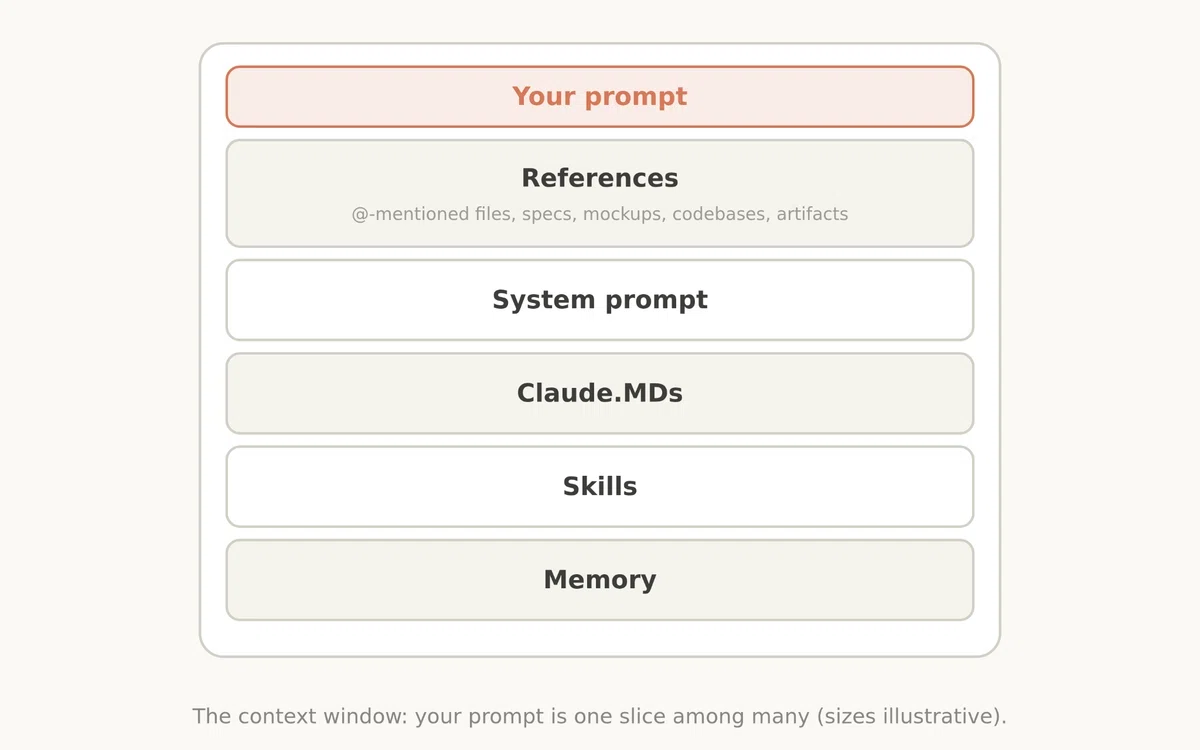
The information passed to the model in Claude Code is not just the prompt written in the input field. It combines system prompts from the product side, CLAUDE.md, Skills, memory, tool definitions, conversation history, @-mentioned files, and reference materials like code and tests. Anthropic calls the overall design encompassing these 'context engineering.' If prompt engineering is the act of refining a single request, context engineering is the act of designing what information is always passed, what information is loaded only when needed, and what is left to the model's judgment.
Overconstraining Claude Code
When Anthropic's development team reviewed internal usage records of Claude Code, they found instances where a single request contained contradictory instructions. For example, one place might say 'leave documentation if necessary,' while another says 'do not add comments.' When system prompts, Skills, and user requests conflict, Claude must decide which instruction to prioritize before starting work. Anthropic describes this state as 'overconstraining.' With older models, strong rules were necessary to prevent file deletion, creation of unnecessary documents, or addition of inaccurate comments. However, keeping the same rules after the model's judgment capabilities improved hinders situation-appropriate judgment. For this reason, Anthropic reduced Claude Code's system prompt by over 80% for Opus 5 and Fable 5.
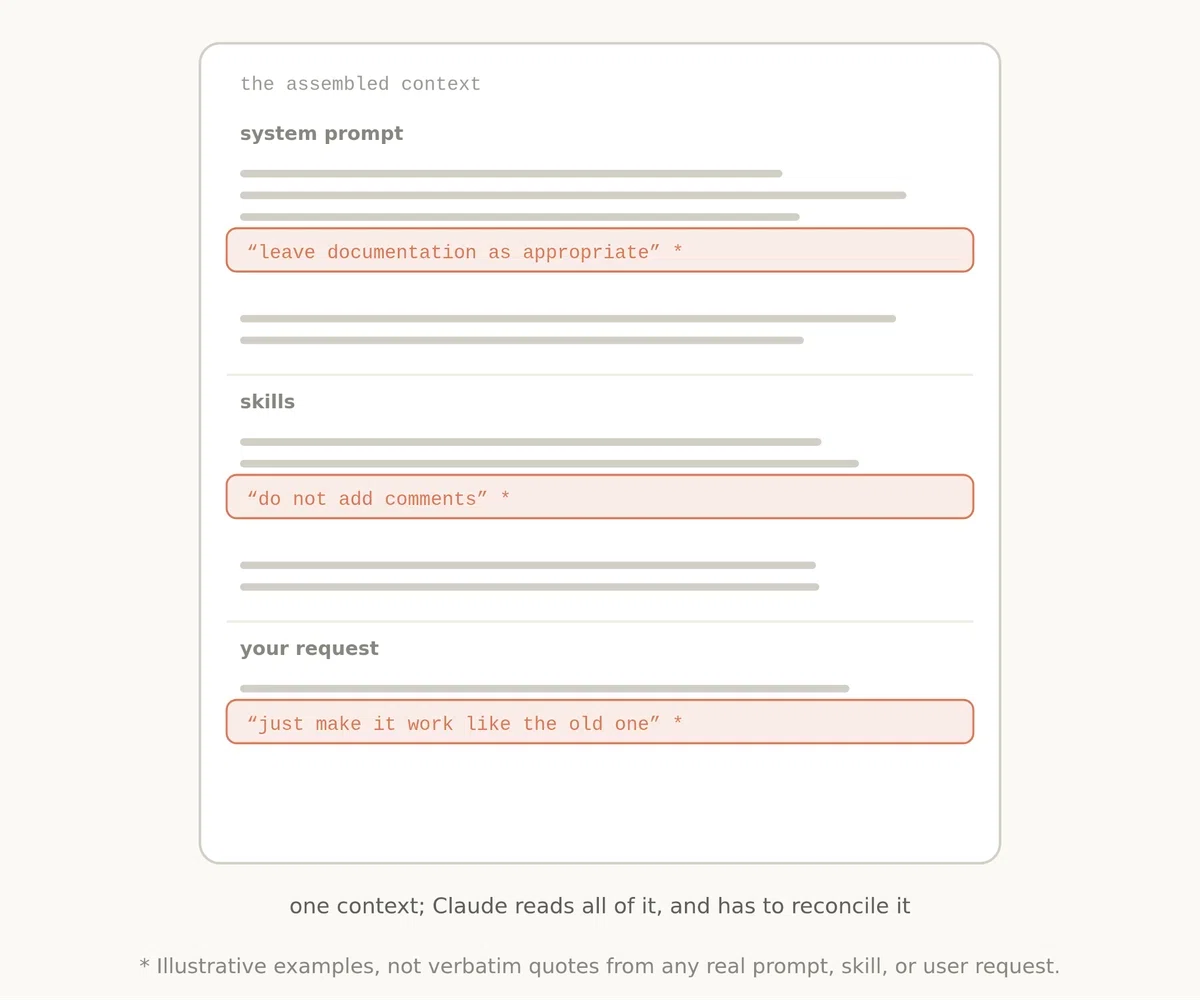 This is an example, but aren't you adding prohibitions or restraints like this?
Instead of Adding Rules, Make it Read the Surrounding Code
Previous Claude Code system prompts included instructions such as:
As a rule, do not write comments in code. Never write multi-paragraph docstrings or multi-line comment blocks; at most, keep them to a short single line. Do not create documents for planning, decision-making, or analysis unless explicitly requested by the user. Work based on the conversation context, not on intermediate files.
These instructions were to prevent older models from creating unnecessary/inaccurate comments or documents. However, the necessity and appropriate length of comments vary by codebase. Complex processes may require multi-line explanations. The new system prompt has been changed as follows:
Write code that reads like the surrounding code. Match the comment density, naming, and writing conventions of the surroundings.
Instead of meticulously stipulating every situation, it allows the model to read existing code and choose the format appropriate for that project. However, clear constraints are still necessary for areas where incorrect operations can have significant impact, such as deletion, external publication, billing, credentials, and personal information. What Anthropic reduced was not the safety requirements themselves, but content that the model could infer from surrounding information, and instructions that were redundant across multiple locations.
Design Interfaces Rather Than Using Examples
Traditionally, the focus for having AI use tools was to provide numerous examples. Anthropic explains that for Claude 5 generation, examples can narrow the model's exploration range. This is because the model might treat the exemplified method not as one possible way, but as the only way. Instead, the focus is on designing the interfaces of tools, scripts, and files.
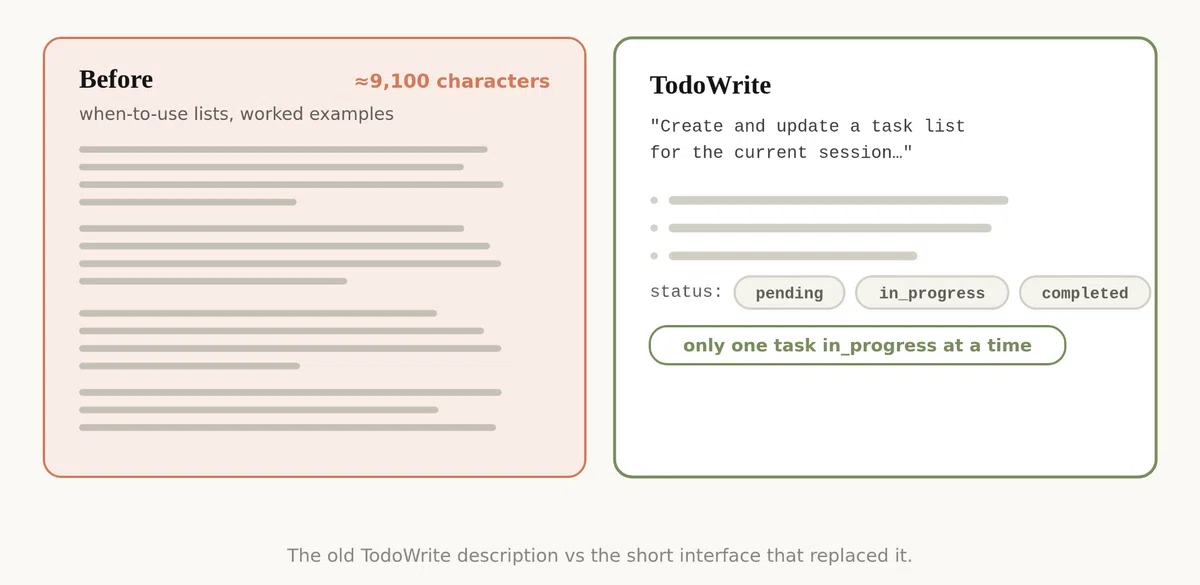
For example, define the state of a Todo tool as the following enumeration:
{pending, in_progress, completed}
This definition allows Claude to understand the possible states and the flow of processing.
Furthermore, by describing 'only one in_progress item at a time' in the tool's description, the expected behavior becomes clear. This is an API developer's mindset: clearly designing input values, states, return values, and constraints, rather than listing long usage examples.
Load Only Necessary Information When Needed
Previous Claude Code also included detailed explanations about code review and verification methods in the system prompt. However, these are not necessary for all tasks. Constantly loading unused information consumes context and buries information relevant to the current task. Currently, verification and code review procedures are moved to individual Skills, and Claude Code calls them only when needed. Anthropic calls this method 'progressive disclosure.'
The same idea applies to tools. Some tools use 'deferred loading,' where Claude searches for the complete tool definition using ToolSearch before use. This allows many tools to be available without loading their definitions into context until they are needed. The same design can be applied to CLAUDE.md and Skill.md. Instead of consolidating all knowledge into one file, provide a file structure that can be loaded when necessary.
Remove Redundant Instructions
In previous Claude models, the same instructions were sometimes written in multiple places. For example, describing a tool in the system prompt and then writing the same content in the tool definition. Since there was a tendency to prioritize instructions at the end of the context over the beginning, repeating instructions had some meaning.
With the new models, this redundancy can be removed. Information placement is separated; tool usage is written in the tool's description, and the system prompt describes the overall role of the product.
Keep CLAUDE.md Lightweight
Anthropic recommends keeping CLAUDE.md lightweight. First, briefly explain what the repository is for. Then, write project-specific caveats that aren't apparent from just looking at the code or file structure. For example, consolidating type definitions into one file, not directly editing auto-generated directories, or having special verification procedures. There's no need to repeat general programming principles or content that can be understood by reading the code. Verification procedures used only in specific situations should be separated into a verification Skill and referenced from CLAUDE.md. CLAUDE.md should retain the project overview and caveats specific to that codebase.
Move Memories to Automatic Memory
Previously, it was common practice to actively use #hotkey to write information to CLAUDE.md and store it as Claude's memory. Current Claude Code utilizes a memory function that automatically saves information related to tasks and users. Therefore, there's no need to append all personal preferences or past work content to CLAUDE.md. Roles are separated: project-shared rules in CLAUDE.md, necessary work procedures in Skills, and continuous memories in automatic memory.
Use Code and HTML as Reference Materials, Not Just Markdown
Claude Code can use more specific reference materials than just Markdown specifications or plans. These include test suites, existing implementations, functions migrated from other codebases, HTML mockups, HTML created with Artifacts, and Rubrics describing evaluation criteria. Files can be passed as reference materials using @-mentions.
@spec.md
@tests/
@mockup.html
Anthropic recommends prioritizing reference materials expressed as code whenever possible. Passing an HTML mockup can more accurately convey structure, hierarchy, spacing, and operations than describing screen designs with text or screenshots. Test code describing expected behavior can also be used as specifications.
A Rubric is an evaluation criteria sheet for deliverables. For example, one can provide criteria such as 'what constitutes good API design' and have a verification agent with those criteria check the deliverable.
Elements Constituting Context
Anthropic's report describes system prompts, CLAUDE.md, Skills, and reference materials as elements for designing context. The system prompt defines what product Claude runs in and what its purpose is. When using Claude Code, users typically do not change it. If building a custom agent foundation, the product's role and permissions are defined here.
CLAUDE.md should contain the repository's purpose and specific caveats. Detailed verification or work procedures should be moved to separate files or Skills. Skills are lightweight guides for loading information or procedures when needed. Long Skills should be divided into multiple files for progressive loading.
Reference materials include specifications, code, tests, mockups, and codebases. Necessary files are added to the current task via @-mentions.
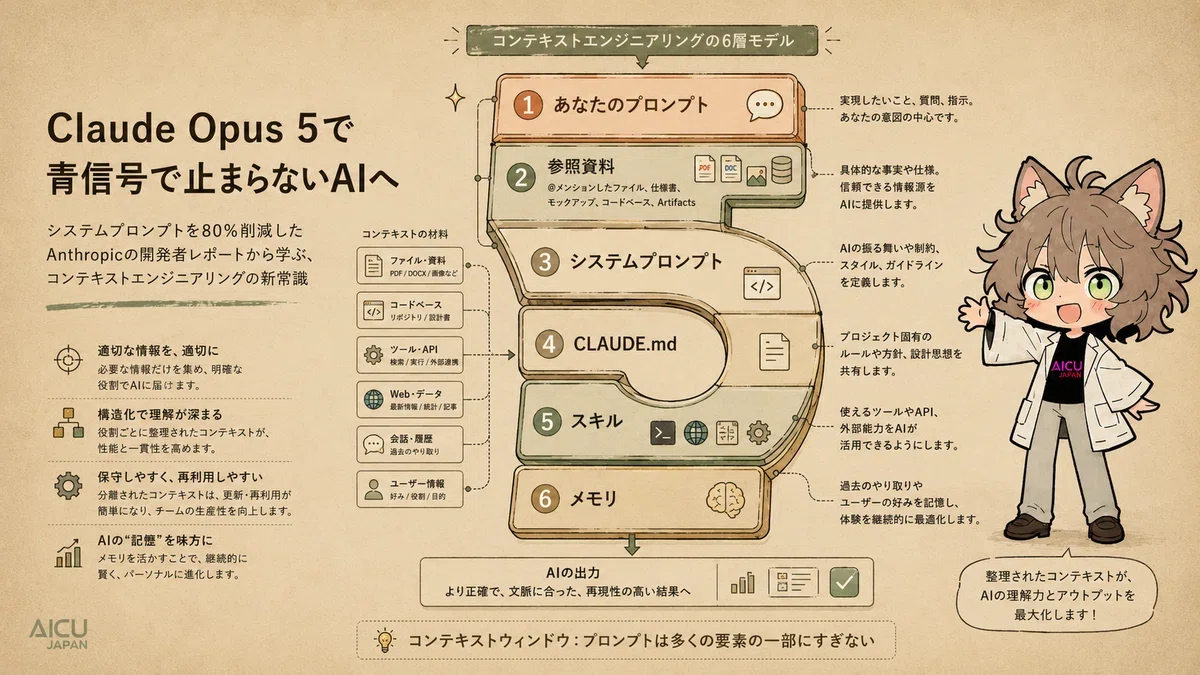
The diagram in this article adds user prompts and memory to these, organizing them as the '6-layer model of context engineering.' This 6-layer model is not formally named by Anthropic but is a diagram organized by AICU based on their report.
Check Claude Code Settings with /doctor
Anthropic explains that they have incorporated these insights into Claude Code's /doctor command. Run the following command in Claude Code:
/doctor
/doctor is a command to check if Skills and CLAUDE.md are of appropriate size, and if there are any issues with settings or context. It checks for redundant instructions across CLAUDE.md, Skills, and tool descriptions, whether content understandable from code is constantly loaded, and if procedures used only for specific tasks can be separated.
Relationship with 'AI That Stops at a Green Light'
The previous article, 'The Socratic Paradox of Ignorance,' addressed the problem where human-obvious goals and premises are not conveyed to AI, while only prohibitions to prevent past failures increase. Rules like 'stop at a red light' are explicitly stated, but purposes or criteria for judgment like 'where are we going' or 'under what conditions can we proceed' are sometimes omitted. This is the problem of 'Unknown Knowns'—what humans know but deem too obvious to verbalize.
Every time AI fails, adding rules like 'don't delete files,' 'don't write comments,' 'don't publish without permission' won't improve AI's judgment if the goals and expected outcomes aren't clear.
The fact that Claude Code's system prompt was reduced by over 80% indicates that information placement and role segregation are more important than the number of rules.
Organize Context, Not Shorten It
Interpreting this developer report as 'shorter prompts are always better' is not appropriate. What Anthropic reduced was content that the model could infer from surrounding information, explanations redundant in multiple places, and granular constraints added for older models. Safety and permission constraints remain. Project-specific caveats are described in CLAUDE.md. Specific work procedures are separated into Skills. Specifications and code necessary for the current task are passed as reference materials. Tool usage is described in the tool definition. Reducing Claude Code's system prompt by 80% does not mean 80% of the information passed to AI became unnecessary. It means reconsidering where to place information and when to load it. For Claude 5th generation, context design that reduces redundancy and overconstraining, assuming the model's judgment ability, is required.
Related Materials
Anthropic 'The new rules of context engineering for Claude 5 generation models'
https://claude.com/blog/the-new-rules-of-context-engineering-for-claude-5-generation-models
Akihiko Shirai 'The Socratic Paradox in the AI Era—To Avoid Creating an AI That Stops at a Green Light'
https://forest.watch.impress.co.jp/docs/serial/aistream/2125391.html
A field guide to Claude Fable 5: Finding your unknowns | Claude | Claude by Anthropic
claude.com Practical patterns for agentic coding with Claude Fable: how
The new rules of context engineering for Claude 5 generation models | Claude by Anthropic
claude.com We removed over 80% of Claude Code's system prompt for more a

Consult AICU AIDX Lab for AI-era engineering here
https://aicu.jp/AIDX