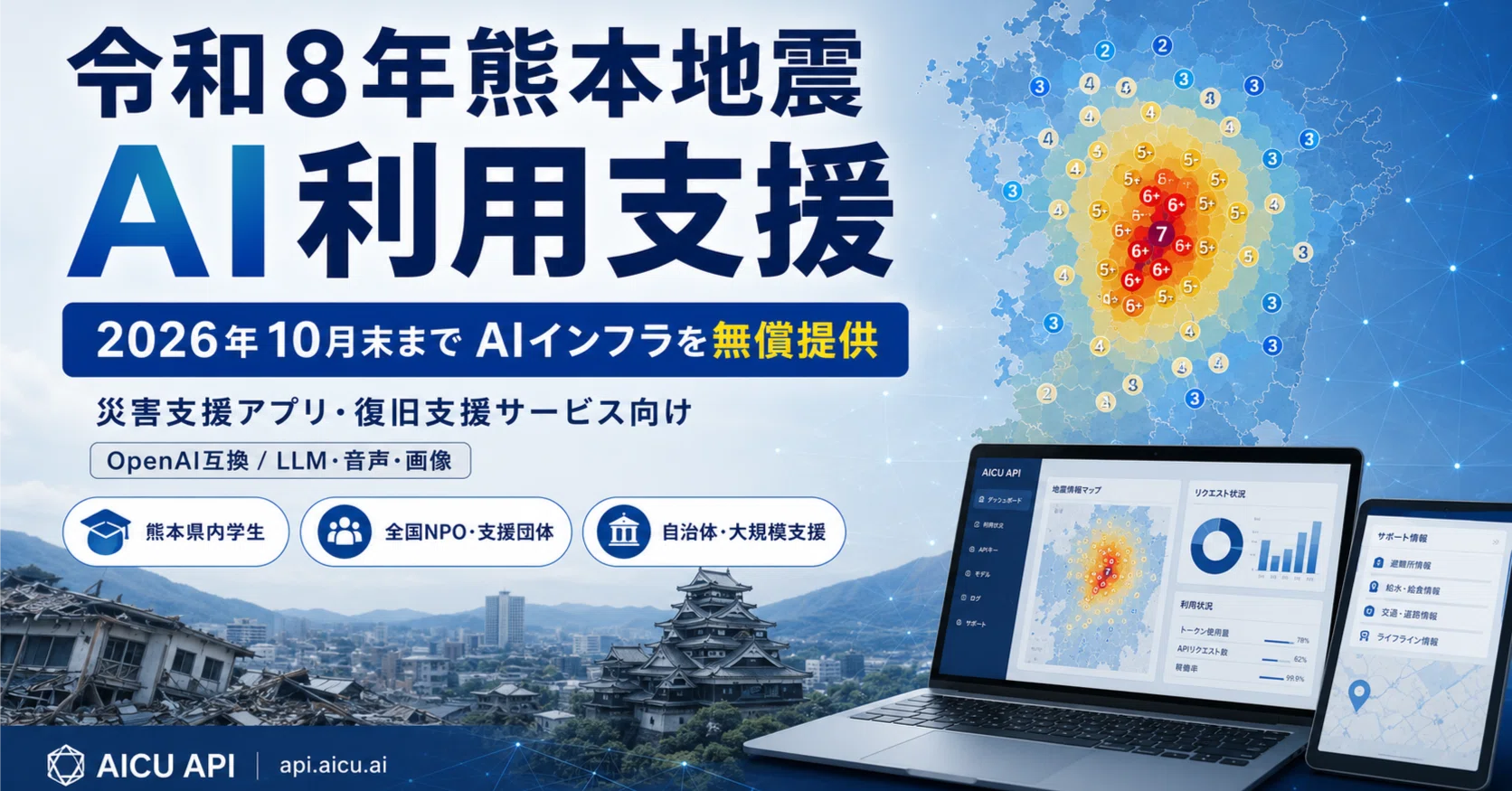
Our deepest sympathies go out to all those affected by the Reiwa 8 Kumamoto Earthquake. We also express our profound respect to everyone involved in rescue and relief efforts, medical care, shelter operations, material transport, and information dissemination.
About the Reiwa 8 Kumamoto Earthquake (July 28, Reiwa 8) | Prime Minister's Office
www.kantei.go.jp This is the website of the Prime Minister's Office.
Around 4:27 PM on July 28, 2026, an earthquake with a magnitude of 7.1 occurred with its epicenter in the Kumamoto region of Kumamoto Prefecture, observing a maximum seismic intensity of 7 in Uki City and Hikawa Town. The Japan Meteorological Agency has named this series of seismic activities the "Reiwa 8 Kumamoto Earthquake."
Even one day after the occurrence, the full extent of the damage is not yet clear.
Looking at the reported damage, serious devastation has occurred across a wide area, including homes, commercial facilities, factories, hospitals, roads, bridges, railways, and cultural properties. While people are waiting for water, have lost means of transportation, and continue to confirm safety and search for loved ones, a large volume of information is starting to gather with local governments and support organizations. The government and Kumamoto Prefecture are also prioritizing damage assessment and rescue/relief efforts.
AICU, which operates with the vision of "creating creators" in the age of AI creators, is seriously considering this disaster and its support. In situations where life and safety are threatened, it becomes difficult to continue enjoyable creative activities. On the other hand, people outside Kumamoto Prefecture should also be able to provide support through information technology and development capabilities.
When AI applications are made public, token and computing infrastructure costs are incurred depending on the number of users. It is not easy to develop and continuously publish support services without knowing how much expense will be necessary.
Therefore, AICU is starting to provide AICU API usage support for those developing applications and services related to the recovery and support of the Reiwa 8 Kumamoto Earthquake. We will provide AI infrastructure free of charge to enable the rapid development and continuous operation of AI applications that can be used by disaster victims and general users.
Free AI Infrastructure for Disaster Support Apps Until the End of October 2026
"AICU API" is an API platform developed by AICU Inc. in the US, and used by AICU Japan as infrastructure for its own services, hackathons, and creator support.
From a common endpoint like https://api.aicu.ai/ and a single API key, you can use OpenAI API compatible LLMs, speech synthesis, speech recognition, image generation, and more.
AICU API - AI-Driven MVP Development
api.aicu.ai API Platform for AI-Driven MVP Development
Developers do not need to manage separate contracts, credit card registrations, multiple API keys, or billing addresses for each AI provider, which are usually required. Usage history is recorded per request, and development is underway to handle authentication, post-payment billing, invoicing, license management, and royalty distribution to character rights holders on the same platform in the future.
Currently, the AICU API Platform is provided as an α version without charge. For applications aimed at recovery and support for the Reiwa 8 Kumamoto Earthquake, no additional charges will be incurred until October 31, 2026, regardless of the timing of the transition to the official version, as long as it does not exceed the total budget of this program.
OpenAI API compatible applications can connect by changing the base URL and API key. Currently, models such as OpenAI, Groq, OpenRouter, Gemini (paid), and Sakura's AI Engine are integrated, and it also supports multi-language speech synthesis by ElevenLabs (paid) and speech recognition by Whisper.
It can also be used with coding agents and AI development tools that support OpenAI compatible APIs, such as OpenCode and Cline. If you are unsure how to connect or encounter problems during use, AICU will provide support as much as possible.
To Publish Apps Needed Only During Disasters, Without Fear of Costs
During disasters, applications not premised on long-term commercialization are also necessary. These include maps showing water supply points and shelters, services for delivering communications from local governments, tools for transcribing meeting audio, multi-language voice guidance, lists of reopened businesses, and learning support during school closures.
Such services see increased API usage fees as more people use them. However, if development starts after predicting user numbers and designing cost limits during an emergency, it may not be ready when needed.
The support AICU is offering this time is not for individual developers' AI usage fees. It supports the AI infrastructure of applications used by disaster victims, local residents, supporters, and local government officials.
This program covers not only newly developed apps but also the addition of disaster response features to existing public services, and the reconfiguration of software published on GitHub etc. for use in affected areas.
Time-Limited Apps Essential During Disasters
For example, we actively support the following "disaster-limited apps":
- Voice recognition and minute creation for disaster response headquarters and local government meetings
- Search and mapping of shelters, water supply points, supplies, and traffic information
- Classification and summarization of inquiries received by local governments and NPOs
- Multi-language translation and voice guidance for foreigners
- Information conversion considering visual and auditory impairments
- Services that redistribute public institution web information to LINE etc.
- Organization of information on reopened stores and medical institutions
- Learning support during school closures
- Services that facilitate cross-referencing public announcements with SNS information
- Emergency app development using coding agents
- Organization and archiving of disaster records including images and audio
- Image protection for privacy preservation
We believe that not only creating new things from scratch but also redeploying services already openly developed on GitHub etc. for disaster use is important support.
The Geospatial Information Authority of Japan (GSI) publishes crustal deformation, active fault maps, and topographic classification data, and also provides information that can be used, including reprinting, by clearly stating the source. We believe that API usage in disaster support apps also has demand for organizing, searching, and interpreting such public data and large-scale open data. Use by universities and research institutions is also welcome.
Akihiko Shirai, CEO of AICU, will also share safe AI utilization methods and support examples during disasters sequentially.
AICU Japan has built most of its services with the AICU API. Furthermore, server infrastructure other than the API uses Cloudflare to reduce maintenance costs and provide applications with enhanced scalability.
On the other hand, AI cannot replace public institutions, experts, or local disaster relief volunteers. This activity is not intended to promote the spread or use of AI itself. Please use it strictly for disaster relief, medical care, evacuation, safety assurance, benefits, infrastructure recovery, and peace of mind in shelters.
Do not make decisions related to human life or rights, such as medical care, evacuation, building safety, benefits, infrastructure, material distribution, and selection of support recipients, solely with AI. Use AI for information organization, search, translation, summarization, input assistance, and suggesting candidates, and always have human confirmation for important decisions.
Three Support Categories
The target groups are envisioned as three categories: ① students in Kumamoto Prefecture, ② NPOs and support organizations nationwide, and ③ local governments/large-scale support projects.
As it is an emergency, there is no need to prepare a formal application document from an organization initially. Individuals who can responsibly manage API keys and usage, such as students themselves, local government officials, faculty and staff, NPO representatives, and development managers, can apply.
This also applies to those developing services for the affected areas from outside Kumamoto Prefecture.
How to Apply
Applications are accepted via AICU Call.
Please create an account with AICU API, then proceed to entry.
**【Reiwa 8 Kumamoto Earthquake】
Free Provision of AI Infrastructure for Disaster Support Until the End of October 2026 #KumamotoPrefectureEmergencySupport
**https://aicu.jp/call/kumamoto260728
https://aicu.jp/call/kumamoto260728
When applying, please provide the email address used for AICU API, your GitHub account, who the application is for, what information and features it will offer, and how you plan to use the OpenAI-compatible API.
Not only completed services but also those under development, functional additions to existing apps, short-term prototypes, and internal business support tools for local governments and NPOs are eligible.
At a stage where the full extent of the damage is not yet visible, the necessary applications and computing resources change daily. AICU will continue to provide support within its capabilities so that people on the ground do not get bogged down by AI infrastructure costs, account creation for multiple services, securing approval for expense settlements, API connection work, etc.
This program is independently conducted by AICU and is not an official disaster support program by OpenAI. AICU Inc. is an OpenAI certified Startup company.
We also welcome contact from companies and organizations considering participation in this program or support in terms of infrastructure, technology, and costs.
The latest information will be shared on X at @AICUai. For inquiries, please use this link: https://aicu.jp/contact